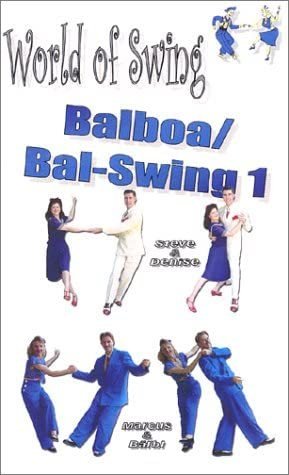
World of Swing – Balboa/Bal-Swing 1 provides structured instruction in the footwork, rhythm, connection, and partner mechanics used in Balboa and Bal-Swing.
The program begins with foundational pulse and basic-step concepts before progressing to crab walks, paddles, cross breaks, circular movements, turns, swing-outs, and rhythmic variations. Marcus Koch & Bärbl Kaufer explain how the figures are led and followed, helping dancers understand both individual movement and partner coordination.
The course also explores transitions between compact Balboa movement and the more open, rotational actions associated with Bal-Swing. Practice demonstrations with music allow students to study timing and see how the material can be combined in social dancing.
This volume is suitable for dancers who already understand basic swing timing and want to develop a broader intermediate Balboa and Bal-Swing vocabulary.
Topics Covered
Section 1 – Pulse & Basic Footwork
- Pulse & One-Step
- Up-Hold & Down-Hold Basic
- Crab Walks
- Crabs on Counts 3 & 7
- Paddles
- Steps to Music
Section 2 – Transitions & Circular Movement
- Transitions & Cross Breaks
- He Crosses, She Crosses
- Come Around
- Swing Step / Lolly Kicks
- Swing in a Circle
- Steps to Music
Section 3 – Turns & Variations
- Inside Turn & Swing-Out
- Reverse Turn
- Steps to Music
- Variations & Exercises
- Ad-Libs
- Double-Time Rhythms
- Shuffles
Course Features
- Detailed explanations of each figure
- Lead-and-follow instruction
- Individual and partnered footwork
- Rhythm and timing exercises
- Demonstrations performed with music
- Multiple practice variations
- Balboa-to-Bal-Swing transition concepts
Suitable For
This instructional video is recommended for:
- Intermediate Balboa dancers
- Bal-Swing students expanding their figure vocabulary
- Swing dancers developing close-position connection
- Leaders and followers improving partner communication
- Dance instructors teaching intermediate Balboa material
- Social dancers working on rhythm and fast-tempo movement
About the Instructors
Marcus Koch & Bärbl Kaufer are internationally recognized swing dance instructors and competitors. Their instructional programs focus on structured technique, rhythm, partner connection, and the practical application of swing dance figures.
Related Products
- World of Swing – Balboa/Bal-Swing 2
- World of Swing – Boogie Woogie 1
- World of Swing – Boogie Woogie 2
- East Coast Swing – Secrets Of Improvisation
- Marcus Koch & Bärbl Kaufer Instructional Videos
Reviews
There are no reviews yet.