
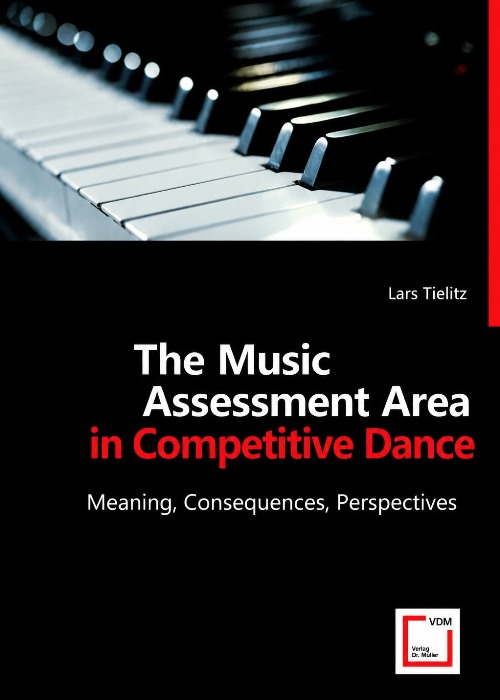
What makes a dance performance truly musical, and how should musical quality influence judging in competitive ballroom dancing?
In The Music Assessment Area in Competitive Dance: Significance, Consequences, Perspectives, Lars Tielitz examines the relationship between music, dance technique, and adjudication in Standard and Latin dancesport.
Rather than treating musicality as simply dancing in time, Tielitz explores how judging criteria shape competitive performance, training methods, and the technical development of dance couples.
Timing, Rhythm, and Musicality
The central discussion focuses on three related components of the Music assessment area:
- Timing: Understanding and responding accurately to the musical beat and its time structure.
- Rhythm: Organizing movement through musical accents, changes in intensity, and rhythmic phrasing.
- Musicality: Interpreting the character and expressive possibilities of music through individual movement.
Using examples from dances such as Cha-Cha-Cha, Rumba, and Paso Doble, the author explains why staying on the beat does not necessarily produce a convincing musical performance.
He also examines how established step patterns and conventional training approaches may limit dancers’ ability to respond creatively to different musical interpretations.
Dance Technique and the Human Adjudicator
An important part of the book concerns the relationship between judging criteria and competition-oriented technique.
Tielitz questions whether technically correct choreography is sufficient when a couple’s movements do not fully reflect the music. He considers how dancers might develop greater flexibility, rhythmic expression, and musical awareness without abandoning technical principles.
The discussion also addresses the challenges faced by human adjudicators, including the difficulty of assessing multiple couples and the influence of judging criteria on competitive priorities.
The final chapters consider musical assessment in individual and formation dancing, together with possible directions for improving judging criteria and dance training.
This is an analytical study rather than a step-by-step dance manual, offering a thought-provoking perspective on how music can influence competitive performance.
Contents
- Introduction to the Subject
- Social Dance
- Partner Dancing as a Competitive Sport
- Differences Between Social and Competitive Dance
- Fundamental Considerations for Competition-Oriented Partner Dance Technique
- Specific Considerations for Competition-Oriented Dance Technique
- Objectives in Competition-Oriented Partner Dancing
- Which Assessment Area Is Most Important for Dance Couples?
- The Music Assessment Area
- Timing
- Rhythm
- Musicality
- The “Problem” of the Human Adjudicator
- Conclusion
- Music Assessment in Individual Competitive Dance
- Music Assessment in Formation Dancing
- Outlook
- Investigation and Optimization of Other Assessment Areas
- Integrating Appearance into Judging Criteria
- Judging Criteria as a Foundation for Competitive Dance Technique








Reviews
There are no reviews yet.