
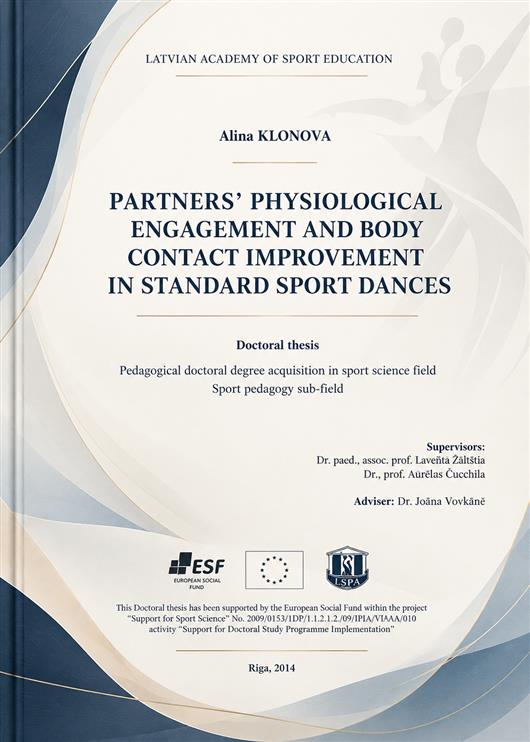
Partners’ Physiological Engagement & Body Contact Improvement
Developing exceptional body contact and partnership connection is one of the most challenging aspects of International Standard ballroom dancing. In Partners’ Physiological Engagement & Body Contact Improvement, researcher Alina Klonova combines scientific methodology with practical dance application to examine how elite Standard dancers create effective body contact and maintain high-quality partner communication throughout movement.
This doctoral dissertation moves beyond opinion-based coaching by providing measurable research into the physiological, biomechanical, and technical factors that influence partnership performance. The study investigates dancers of different ages and skill levels, analyzing how body structure, physical conditioning, and movement mechanics contribute to successful Standard dance technique.
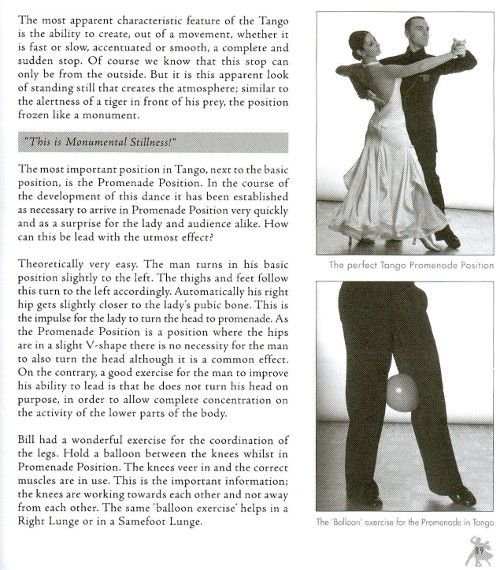
A major strength of this ebook is its focus on translating scientific findings into practical training recommendations. Readers will gain valuable insights into improving posture, balance, frame stability, partner alignment, and body contact efficiency while maintaining the freedom of movement required for high-level ballroom dancing.
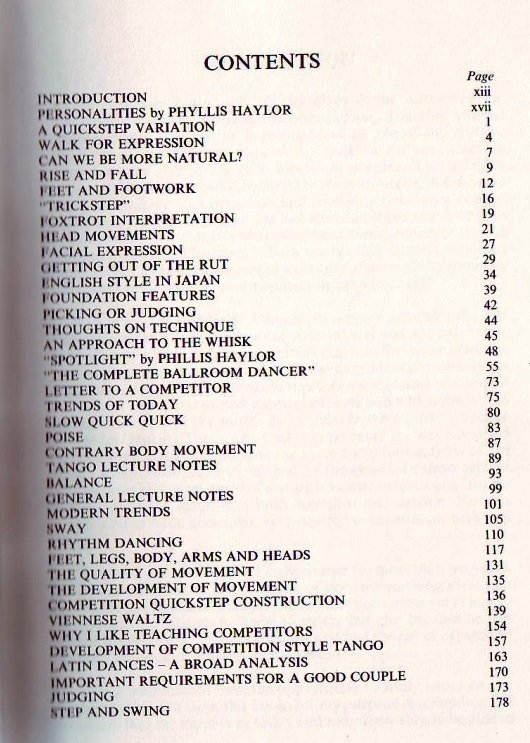
TABLE OF CONTENTS
- LIST OF FIGURES
- LIST OF PICTURES
- LIST OF TABLES
- INTRODUCTION
1. TECHNIQUE DEVELOPMENT AND PHYSICAL CONDITIONING IN STANDARD SPORT DANCES
1.1 Dancesport Emergence and Development
1.2 Training Process Characterization in Sport Dances
1.3 Anatomical, Physiological and Psychological Characteristics of the Adult Group Athletes
1.4 Technique and Teaching Analysis in Standard Dances
2. TASKS AND METHODS OF THE RESEARCH AND EXPERIMENT ORGANISATION
2.1 Tasks of the Research
2.2 Methods of the Research
2.3 Research Organisation
3. DEVELOPMENT OF PRACTICAL RECOMMENDATIONS FOR ACHIEVING PARTNERS’ BODY CONTACT MODEL IN STANDARD DANCES AND EVALUATION
3.1 Analysing the Characteristics of the Body Contact in Dancers of Different Ages and Skills
3.2 Determining The Anthropometry and Partners’ Biomechanics for Body Contact Improvement
3.3 Determining the Physical Preparation and Partners’ Physiological Engagement
3.4 The Relationship Model Between Partners’ Physiological Engagement and Body Contact Condition
3.5 Contents and Materials of the Standard Dance Training Process and Practical Recommendations for Body Contact Improvement
- DISCUSSION
- CONCLUSIONS
- REFERENCES
- ANNEXES




Reviews
There are no reviews yet.