
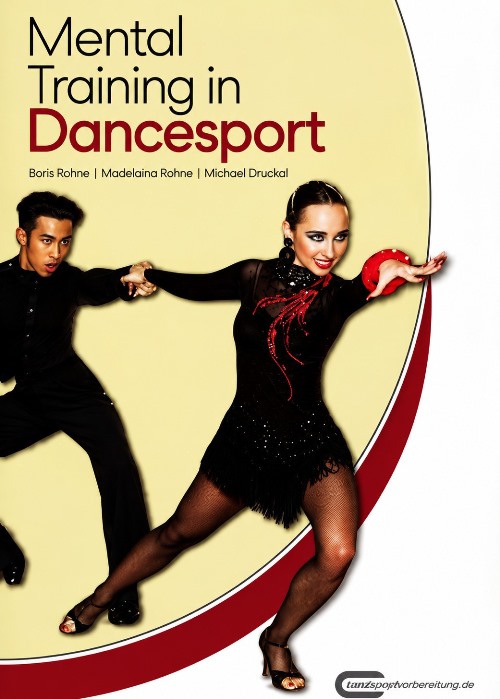
Mental Training in DanceSport by Boris Rohne, Madeleine Rohne, and Michael Draksal is a practical guide for competitive dancers and coaches who want to improve training efficiency, strengthen mental skills, and perform more confidently under competition pressure.
The book presents structured visualization and mental rehearsal techniques to help dancers learn movement sequences faster, improve technical precision, and develop reliable movement memory. Practical exercises include creating personal mental scripts, identifying key movement points, developing movement sensations, controlling activation levels, and monitoring progress.
Beyond dance technique, the authors introduce the Big Seven factors influencing competitive performance: fitness, nutrition, mental strength, technique, tactics, equipment, and environment. Additional methods address motivation, time management, overcoming procrastination, concentration, and learning from mistakes and setbacks.
A dedicated section explores mental preparation for dance competitions, including adapting to tournament pressure, developing body awareness, achieving flow, building realistic self-confidence, and handling unexpected situations. The book also introduces practical strategies such as performance forecasting, feedback exercises, decision-making, and creating a Plan B.
Developed from mental preparation for the 2006 and 2007 Professional Ten Dance World Championships and more than 500 mental training sessions, this guide emphasizes regular practice and the integration of mental exercises into everyday dance training.
Especially suitable for competitive Ballroom Standard and Latin dancers aged 14 and above, the methods can also be adapted to other competitive dance disciplines.
Contents
1. Mental Training – An Introduction
An introduction to the principles and practical application of mental training in dancesport.
2. Learn Movement Sequences Faster & Stabilize Them Mentally
- Introduction
- Preliminary visualization exercises
- Creating a mental script
- Memorization and mental presentation
- Identifying key points
- Integrating movement sensations
- Determining intensity
- Mental technique training
- Methods for monitoring progress
- Recalling performance in competition
3. Accelerating Overall Performance Development
The Big Seven performance areas:
- Conditioning
- Nutrition
- Mental Strength
- Technique
- Tactics
- Equipment
- Environment
Additional topics include:
- Increasing motivation
- Monitoring performance and progress
- Time management
- Improving concentration
- Dealing with mistakes and setbacks
4. Performing Better in Competition
- Adapting to competition pressure
- The Flow Pyramid
- Body awareness
- Body sensation
- Movement sensation
- Flow
- Building mental strength
- Positive feedback
- Identifying personal strengths
- Confidence in action
- Plan B
- Dealing with blackouts
- Challenging personal limits
- Transferring mental skills to high-pressure situations
The book also includes a bibliography and index.





Reviews
There are no reviews yet.