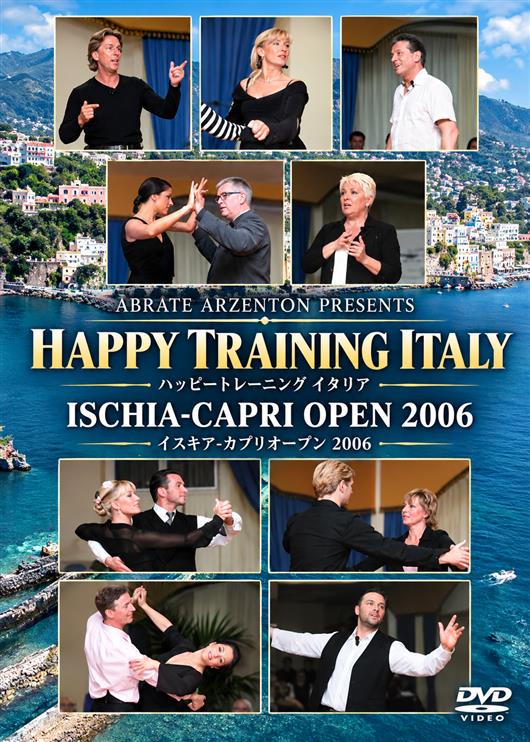
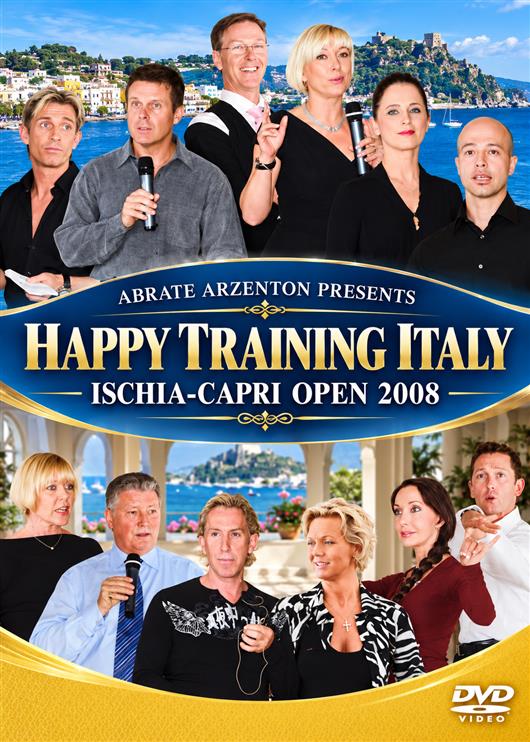
2006 Happy Training Italy – Ischia-Capri Open is an extensive dance training collection featuring 12 lectures from internationally renowned Ballroom and Latin coaches, recorded at the Dance Camp of the Ischia-Capri Open 2006 in Italy.
The program covers Waltz, Slow Foxtrot, Tango, Quickstep, Rumba, Samba, Jive, Cha Cha Cha, and Paso Doble. Rather than focusing only on choreography, the lecturers explore essential principles including quality of movement, timing and rhythm, body action, posture, connection, balance, foot and leg action, swing, rotation, accents, and dance character.
Presenters include Marcus Hilton MBE, David Sycamore, Caterina Arzenton, Espen Salberg, Michael Stylianos, Shirley, Karen Hilton MBE, Donnie Burns MBE, Denise Weavers, Lorna Lee, and Massimo Giorgianni. Several lectures combine explanation with demonstrations, workshops, exercises, choreography analysis, and practical work with dancers.
Originally released as a 4-DVD set, this collection preserves a substantial series of lectures for dancers, teachers, competitors, and anyone interested in the technical and artistic principles behind high-level Ballroom and Latin dancing.
Contents
- Marcus Hilton MBE – Waltz (40 min)
Explores how quality makes dancing more attractive and interesting. Using the three main Waltz actions and popular figures, Marcus explains why developing quality of movement is essential to improving performance. - David Sycamore – Slow Foxtrot (43 min)
Examines the timing of correct Slow Foxtrot action through clear examples of correct and incorrect execution. Explains how different types of weight changes can be used to control the timing of different rhythms. - Caterina Arzenton – Slow Foxtrot (37 min)
Begins with the thought-provoking statement that Slow Foxtrot is not a Swing Dance. The lecture also addresses the lady’s understanding of correct footwork, timing, body connection, center awareness, movement, and effective following. - Espen Salberg – Rumba (39 min)
Explores body action, timing, connection, and important aspects of Rumba character, with demonstrations by Slavik and Elena. Emphasizes that strong basic principles remain essential regardless of the complexity of the choreography. - Michael Stylianos – Samba Workshop (44 min)
A practical workshop exploring how changes in shape, timing, accents, and the addition of turns can transform familiar figures and make Samba dancing more interesting and attractive. - Shirley – Jive Workshop (34 min)
Explains important characteristics of Jive with demonstrations by Shirley and Riccardo. Includes effective exercises and combinations designed to develop a clearer understanding of Jive character. - Karen Hilton MBE – Tango Workshop (39 min)
Covers Tango posture, timing, style, foot speed, and body speed. Using popular figures danced by participants, Karen demonstrates the importance of balance and the correct use of the feet, legs, and body. - Donnie Burns MBE – Cha Cha Cha (45 min)
Examines normal and syncopated timing, the difference between a walk and a step, and the correct use of delayed and normal walks. These principles are explored through analysis of Slavik & Elena’s choreography. - Denise Weavers – Tango (34 min)
Explains the correct direction of power in Tango together with posture, connection, frame, and clear timing. Demonstrates how Legato Slows and Staccato Slows require different movement and timing qualities. - Lorna Lee – Paso Doble (54 min)
Studies the character and background of Paso Doble and explains why understanding the origins and meaning behind individual figures can lead logically to more appropriate technique and a more convincing performance. - Caterina Arzenton – Waltz (28 min)
Covers advanced Waltz technique for creating deep swing and rotation. Working with a young couple, Caterina explains changes in contact position during swing, correct leg action, and awareness of the couple’s common center. - Massimo Giorgianni – Quickstep (37 min)
Explores how rhythm is created in Quickstep through nine different types of accents. Massimo demonstrates how combining these accents can produce a richer and more clearly defined rhythmic performance.



Reviews
There are no reviews yet.